
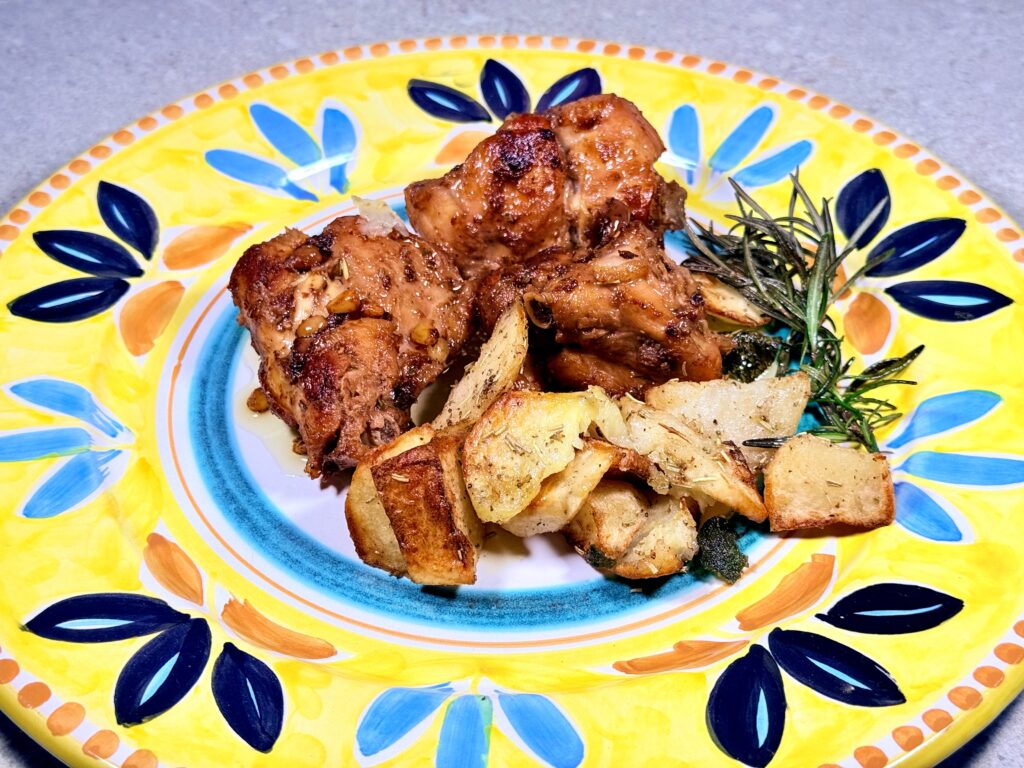
Ligurian rabbit is one of those dishes that rewards patience without asking for complexity. The recipe comes from the Ponente Ligure — the western stretch of the Ligurian coast, where Taggiasca olives grow on steep terraced hillsides and appear in almost everything worth eating.
What makes this dish is the combination of three simple things done right: a proper sear on the rabbit, a good meat stock, and the restraint to add the olives and pine nuts only halfway through cooking — late enough to keep their character, early enough to give them time to settle into the sauce.
The sauce itself should be dark, glossy and syrupy — the result of red wine and collagen-rich stock reduced slowly around the meat. If it looks like a thin broth, it needs more time. If it coats the back of a spoon and falls slowly, you’re there.
Serve with roasted potatoes on the side. Or, even better, a thick slice of crusty bread to mop up what’s left in the pan.
Ingredients
- 1 whole rabbit, cut into pieces (~1.2–1.4 kg cleaned weight)
- 100–120 g pitted Taggiasca olives (in brine, drained)
- 40–50 g pine nuts
- 1 medium onion, finely chopped
- 2 garlic cloves, finely chopped
- 1 sprig of rosemary, finely chopped
- 200 ml dry red wine
- 300–400 ml hot meat stock
- Extra virgin olive oil, as needed
- Salt, black pepper
Quick stock (if you have the rabbit head or trimmings):
- Head/trimmings, 1 carrot, 1 celery stalk, half an onion, cold water
- Simmer for 30 minutes, strain, keep hot
Side dish:
- 600–700 g yellow or red potatoes, cut into wedges
- Extra virgin olive oil, salt, rosemary
Directions
- Pat the rabbit pieces thoroughly dry with kitchen paper — surface moisture prevents proper browning.
- Sear the rabbit in hot oil over high heat, without crowding the pan — work in batches if needed. Large pieces: 4–5 minutes per side. Small pieces: 2–3 minutes per side. What to look for: a uniform golden crust and a strong sizzle.
- Remove the rabbit and set aside. Lower the heat. In the same pan, add the chopped onion and garlic — soften for 3–4 minutes. What to look for: onion translucent and soft, not browned or burnt.
- Return the rabbit to the pan. Add the chopped rosemary and let everything infuse for 1 minute.
- Deglaze with the red wine over high heat. Allow the alcohol to evaporate completely. What to look for: the sharp smell of alcohol is gone, about 2–3 minutes.
- Add 2 ladles of hot stock. Cover with a lid and cook over low heat. Season with salt halfway through cooking.
- Halfway through cooking, add the Taggiasca olives and pine nuts. Add more stock if the base dries out too much.
- Remove the lid for the last 5–10 minutes and raise the heat slightly to reduce the sauce. What to look for: the sauce is syrupy and glossy, coating the back of a spoon and falling slowly when poured.
- Adjust salt and serve with the potatoes on the side.
Cooking times
| Piece size | Covered cooking | Start checking at |
|---|---|---|
| Large pieces (standard) | 50–60 min | 40 min |
| Small pieces | 30–35 min | 25 min |
The meat is ready when it pulls away from the bone with gentle pressure, without falling apart completely.
Notes
- Sear the rabbit before making the soffritto — adding onion and garlic first risks burning them while browning the meat
- Add olives and pine nuts halfway through, not at the beginning — they will burn and turn bitter with long cooking
- Meat stock is non-negotiable for the syrupy finish — the collagen is what creates the glaze
- Do not salt at the start — the olives are already salty; always taste halfway through and adjust at the end
- This dish is even better the next day — reheat gently over low heat with a splash of stock